A Brackish Confluence
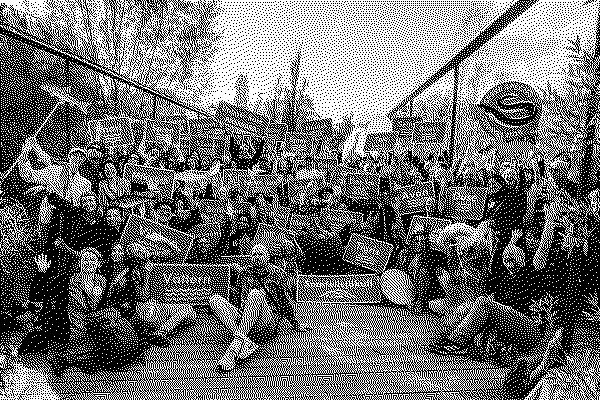
Water moves as time, in its own bed, at its own pace. Those of us connecting with water can't but synchronize and find a proper rhythm to evolve together, with water, in concert, in alliance. Four days with the river Spree in Berlin have shown as much. We gathered, from all over Europe, for the fourth Confluence of European Water Bodies. This Confluence slowly seeks for a common desire among, I think we are forty now: collectives, highly concerned with the fate of rivers, lagoons, lakes, seas and the ocean and/but polyphonic as to goals and priorities. Where to flow? At this point the water bodies spread, as the river's arms on to a delta.
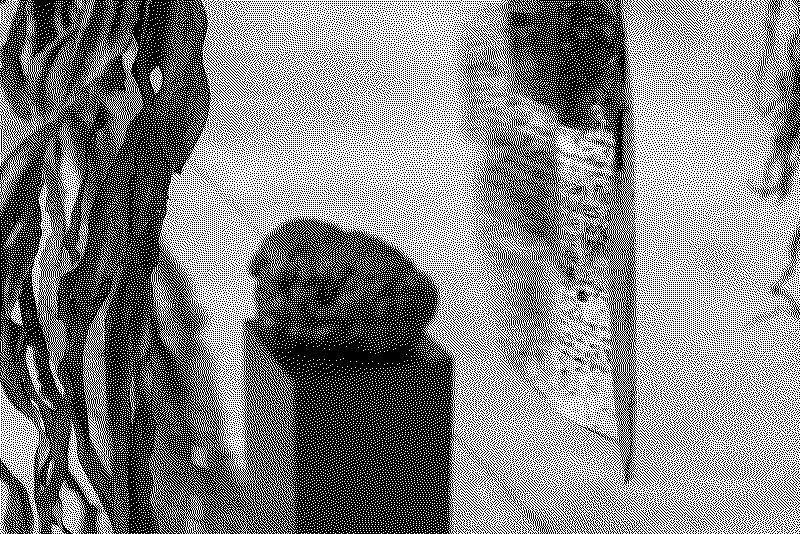
With A Seat for the Sea we brought Sounding Shells to the Confluence in Berlin, an auditory, sensory, and pseudo-rational entry into the deep sea, conceived as an ensemble of porcelain shells surrounded by laminaria (brown seaweed, from the Atlantic Ocean), and facsimiles with anthropocentric declarations. Put your ear to the shells and ocean life speaks to you. The installation stays until November at Spore-Initiative, a cultural and community center in Berlin-Neukölln. It fits into a participatory space and invites visitors to engage with the ocean by sharing their auditory, visual and olfactory memories through text or drawing. On day 2 of the Confluence, we organised a workshop for the participants, amidst the shells and seaweed. Together, we have explored possible strategies to ally with the ocean and other bodies of water: legal rights? a right to opacity? unnaming? outright sabotage? to prevent deep-sea mining – the central theme of our research – and other forms of extraction and intrusion. All of us moved in the space, first as individuals, but explicitly paying attention to the others, then merging into a group. And once the group felt as a kind of single body, we went on to give shape to abstract forms, using a 30 meter long ribbon as collective tool, a square, a triangle, a circle. And what if the ribbon now mimicked watery shapes, of a jellyfish? a riverbed? Human activity takes on rigid forms – grids – in order to confine the so-called ‘wilderness’ for productive purposes. What tactics can counteract the fragmentation of water bodies and disrupt and dismantle the grid – which forms the basic organisational structure of the extractive industries?
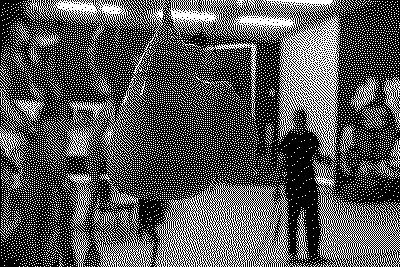
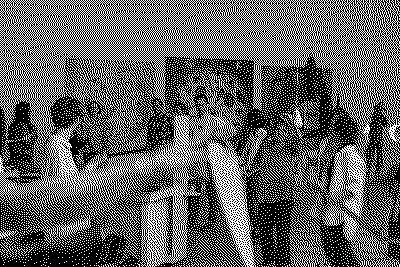
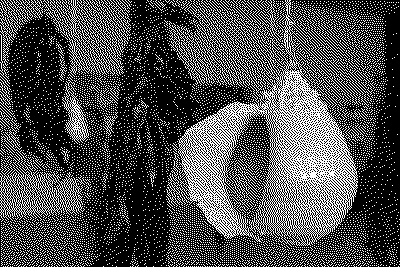


Workshop A Seat for the Seat @Spore Initiative
6 items
Brackishness
These lines from our performance at the UN Ocean conference in Lisbon in 2022 set the tone for the workshop:
'Our house is a very very very fine house
It has this grand facade
But it is old
At our house we interrupt the rainwater pipe
and tap sweet water to clean floors and water plants;
spilled water disappears into the sewer, the sewer leads to the river
and the stream gives way to the delta where sweet and salty meet
before blending into the sea
our head aches - we worry
our old house is getting hot
there’s times that our roof is dry
and we must use water from the tap to clean floors and water plants
all the water flows to the sea
but the sea is never full'
Berlin was only the fourth Confluence of European Water Bodies. But this gathering has already ritualized some of its happenings as constituent parts. And so all of us assembled for a ceremony to Join the Waters that all of us brought to Berlin. We'd brought a water sample, from Woolwich, on the river Thames in London, a yellowish muddy sample, as one can imagine. Not discernible though, unless you'd taste it, is that salty and freshwater mix in our water sample; it is brackish, with sweet water coming from the inland and salty water being pushed upstream by the rising tides from the North Sea. This water sample now with many others is part of the Confluence's collection, kept in one vessel, as a singular expression of affection between rivers, lakes, glaciers and seas.
'Sintering' is an appropriate description of this process. The word was evoked by the Canadian writer Leanne Betasamosake Simpson in her book Theory of Water - Nishnaabe Maps to the times ahead and revived by Spore's curator Lotta Schäfer when she addressed day 2 of the Confluence at Spore-Initiative. In this context, 'sintering' reaches beyond cross-geographical connectedness or solidarity. With the words of Leanne Betasamosake Simpson it means 'living in a way that bonds to different forms of life... plant life, animal life and all the other planetary forces that existed before humans'.
This state of mind is indebted to generations of ecologists, thinkers and activists. It’s still very much on the fringes, but slowly making its way to the edge of the mainstream. One of the aims of the Confluence is to advance rights of nature of water bodies: they meander, they change course, they act fiercely, they are living 'entities' that have the right to be respected as sovereign beings and that must be granted legal status to enforce their own interests and rights to existence, protection and restoration. The emblematic European case in this respect is Mar Menor - site of the first Confluence in 2023. This lagoon near Murcia in Spain, victim of severe pollution from agro-industrial and other extractive activities, gained legal personality after maintained campaigning by its human neighbours. It can't any longer be mistreated as ‘resource’ for the benefit of humans, in theory at least, because democratic rights must be defended over and over again.
Also from Canada came Astrida Neimanis, who as a hydro-feminist published the very influential Bodies of Water. Astrida marked the opening of the Confluence with a keynote. It weaved the story of her grandparents, fleeing from Latvia and emigrating to America, into a Thick Confluence of 'stories that come together, diverge, combine, and overlap'. Velta, her mother's mother when she fled, only brought with her two buckets, a bucket of honey and a bucket of salt, 'because they might be useful'. 'Salt is used to preserve things. Honey helps take away the pain', Astrida went on. 'And isn’t that all any of us can really do, as we embark on the intentional but also accidental and inevitable work of confluencing? To preserve, to dissolve. To remember, and forget. To attend to damage, and never let go of desire. To carry what we can, and to offer something useful.' Honey and salt, or 'brackish after all ... two things can be true at the same time ... a different future for us requires to have the capacity to keep carrying these contradictions within and as our bodies of water. Perhaps brackishness, swimming in the halocline where damage and longing converge, is also another way of describing ‘confluence'.
There is more. Astrida Neimanis invited us to contribute 60-word-vignettes of water memories. 'What does your water body remember?' She incorporated these thoughts in her text and invited the authors to read them aloud as brief interludes during her keynote speech. It made her train of thought even thicker, more viscous if you like, just as water becomes denser the deeper into the water column. The vignettes complemented the sweet-salty brackishness with other, pungent flavours. Our 60-word vignette foreshadows violence. It speaks from the depths of the sea:
'In nov ’22, a miner lobotomized my seabed in the pacific,
when he grabbed 4500 tonnes of nodulesnodules are pebbles
they form when particles from my waters cluster around common nuclei,
one millimeter per million yearsthe particles hold parts of my long history:
remove nodules and you rob me of brain and soul.'
Like a braided network
The Confluence took of at the Reethaus, with collective musing, in open air, on the Spree's riverside. Inside, Neimanis’ keynote resonated magnificently, in the acoustically pristine space under the reed roof. Afterwards, local Spree stories about the Reethaus wiggle into our ears. This bend in the river once was a Flussbad, a public swimming pool, the water heated with cooling water from a power plant across the street. Now, the riverbank is private property, as are so many of the Spree's riverbanks. It is the showpiece of a campus owned by project developers with an international portfolio in the hi-end hotel business. They describe themselves as 'a collective of people, places and projects that reframe the way we live and interact'. Which prompted some sarcasm from the Freitag magazine. It expected this development to become a meeting place for 'similarly thinking people, CEO's, managers, who can find a little quiet and sense here'. Reethaus is a stylish design, we admit, but seen in this light, it also symbolizes the slow but intense pressure on the public space and runs counter the alignment of the Confluence.
The Spree Team did an incredible job in terms of organization, hospitality, and planning, and in bringing us all together for thought provoking events at the Reethaus, Spore, Spreepark, and the Floating University. Amid the carefully curated moments, many inspiring encounters took place. The breaks were just as important for making valuable new connections, processing and reflecting on the experiences we’d gained, and sharing our own knowledge.
What's next: will there be a follow-up in 2027? and who is willing to take it on? Everything is possible, all is open, there is no template. Some have evoked opportunities for a Confluence in 2028 in Brussels. On Day-4 in Berlin, at the Floating University, Francesco Martone (who works with the Global Alliance for the Rights of Nature, GARN) launched a call for cases that can be treated by a Tribunal. Such a Tribunal would be 'a forum for people to speak on behalf of nature (...) and to make recommendations about Earth’s protection and restoration'. These Tribunals also 'enable Indigenous Peoples to share their concerns and solutions about land, water and culture with the global community' (rightsofnaturetribunal.org). In August, a Pan-Amazonian Tribunal in Ecuador recognized the Amazon as a 'subject with integral rights' and declared it 'a fossil fuel exclusion zone'. Because so many water bodies are mistreated, abused, raped, a 'Rights of Nature Tribunal for Aquatic Ecosystems' clearly makes sense. Which is why we as A Seat for the Sea proposed that such a Tribunal supports the global call for a ban on deep-sea mining. Another idea circulates. It thinks of celebratIng the fifth Confluence in 2028 in Brussels on the doorsteps of the European Parliament and Commission.
After the Mar Menor in Spain, the Venice lagoon and rivers, the Northsea coast in the Netherlands and the Spree in Berlin, Brussels might be an obvious destination for its political clout, but less so for our water bodies. The river SZenne (from the Dutch Zenne and the French Senne), the main natural water body in the Brussels landscape, has been largely made invisible. The stewards of this water body, the Natural Contract Lab, were present in Berlin too. They have been organizing Walks With the SZenne for three years, the most recent one on Saturday 26 September. But to accompany the river, they are forced to gather up- or downstream from Brussels. Here, in the Pentagon, the historic city centre, the SZenne is everywhere, yet you can't see or touch it.
The city's name points at its medieval origin, Bruocsela, the hamlet in the marshes, in between the many channels of the river. Together these channels formed 'un réseau en tresse', a braided network. But when the city grew, most channels were closed. Then, in the 19th century, what remained of the main branch was confined into shafts and completely vaulted, to serve public health and ambitious Paris-style urbanisation. This domestication is slowly being reversed. Where the river leaves the Brussels agglomeration, a few hundred meters of vaults have been laid open. Plans to do the same, closer to the Pentagon, are on hold.
When the “Confluence of European Water Bodies” comes to Brussels, it can draw inspiration from the S-Zenne and function as a braided network, in which the riverbed breaks out of its infrastructural boundaries, and every single branch, every single water body sovereignly decides where and how it wants to flow, but where the channels converge - not as a (non-)governmental current serving a single specific timeframe with a single specific goal, but as a mental movement that broadens its bed and collectively finds its own pace.
'how can we abandon selfie`shness?
ally with these COMRADES?
Organize, Join Forces, Agree on Protocols and Tactics
learn a Common LANGUAGE
and speak a language of gestures and sounds?'
from Beyond the dirt, in 5 selfies, a performance of A Seat for the Sea